
Head officeSiège social 877-848-8294 · WhatsApp +1 833-772-5272

Category: Know before you go

  • No Smoking / Vaping: Why?

    No Smoking / Vaping: Why?

    Why There’s No Smoking or Vaping on Commercial Vessels in Ottawa & Ontario

    If you’ve ever been on a Palapa Tour or AquaTaxi.Solar and wondered why smoking and vaping aren’t allowed onboard, you’re not alone. Many guests are used to the more relaxed rules on private leisure vessels, where smoking is often permitted. However, commercial vessels like ours operate under a completely different set of regulations, and for good reason!

    The Key Difference: Commercial vs. Private Vessels

    In Ontario, the rules for commercial vessels are significantly stricter than those for private boats. While leisure boat owners can set their own policies, we must adhere to Transport Canada regulations, Ontario’s Smoke-Free Laws, and strict safety protocols to ensure the well-being of all passengers and crew.

    Why Smoking & Vaping Are Prohibited on Commercial Boats

    1. Fire Hazards on Board 🔥
    • Boats are confined spaces made from materials that can ignite quickly.
    • A small spark from a cigarette or vape could lead to serious fire risks, especially with canopies, upholstery, and fuel systems nearby.
    • Unlike on land, where emergency services are minutes away, a fire on the water can be catastrophic due to limited escape routes and access to firefighting resources.
    1. Transport Canada Regulations ⚓
    • As a commercial vessel operator, we must follow strict safety guidelines under Transport Canada’s Small Vessel Regulations.
    • These regulations explicitly prohibit smoking in areas where fuel, engines, or enclosed spaces could pose risks.
    • Failure to comply could result in fines or even loss of our operating license.
    1. Ontario & Quebec’s Smoke-Free Laws 🚭
    • Ontario law bans smoking and vaping in workplaces and enclosed public spaces—and commercial boats are considered public spaces.
    • Whether docked or sailing, these laws apply to our vessels just like they do to restaurants, patios, and public transportation.
    1. Comfort & Enjoyment for All Guests 🌊
    • Smoke and vape emissions linger in small, enclosed areas, making it uncomfortable for non-smokers, children, and those with respiratory conditions.
    • Guests expect a fresh-air experience on the water, and we aim to provide a clean and enjoyable environment for everyone.

    What About Private Boats?

    Many private boat owners choose to allow smoking, but this does not apply to licensed commercial vessels. If you’re looking for a cruise where smoking is permitted, your best option is to rent a private boat with a personal operator—but keep in mind that fire risks still apply.

    Our Commitment to Safety & Compliance

    At Palapa Tours & AquaTaxi.Solar, we prioritize passenger safety, environmental responsibility, and compliance with regulations. While we understand that some guests may wish to smoke or vape, we kindly ask that you do so before boarding or after disembarking.

    Alternatives: How to Plan Ahead

    • Enjoy a smoke-free cruise by using nicotine alternatives before boarding.
    • Let our team know if you need accommodations—we’re happy to provide breaks at designated stops if needed.
    • Respect fellow passengers who expect a clean-air experience.

    Final Thoughts: A Safe & Enjoyable Experience for All

    The no-smoking and no-vaping rule isn’t about limiting fun—it’s about protecting everyone’s safety and ensuring compliance with the laws that govern commercial vessels in Ontario. Our goal is to provide a relaxing, worry-free experience for all guests while keeping our boats clean, safe, and in top condition.

    We appreciate your understanding and look forward to welcoming you aboard for an unforgettable adventure—smoke-free, stress-free, and full of good vibes! 🚤🌴
  • But I Thought I Booked with You?

    But I Thought I Booked with You?

    The Truth About OTAs and Why It Matters

    It happens more often than you’d think—guests arrive excited for their Palapa Tour, only to say, “Wait, I didn’t book directly with you?” Yup, it’s a thing. Many people unknowingly book through a reseller rather than with us directly, which means they might miss out on some perks we love to offer. Let’s dive into the nitty-gritty of OTAs (online travel agencies) and why it’s worth knowing who you’re booking with.

    What’s an OTA (aka Reseller)?

    Think of OTAs like Viator, GetYourGuide, Expedia or other big travel platforms. These companies partner with tour operators to help market their experiences far and wide. In theory, it’s a win-win: operators get more exposure, and travelers find cool activities easily. But in reality, there’s a catch. Actually, several catches.

    The Good: Global Reach

    When we first started Palapa Tours, OTAs were lifesavers. They got us noticed—fast. In fact, our very first booking ever came from Viator (shoutout to TripAdvisor!) and it was a family from South Africa. Yep, our first customer wasn’t from Ottawa, Toronto, or even North America! They booked their hotel, saw us listed, and said, “Hey, a floating tiki bar sounds awesome.” We were thrilled. In fact, we even printed and framed the confirmation email like a trophy. Think of it like the first dollar bill a shopkeeper makes—it’s special.

    The Bad: Marketing Overload

    Here’s the downside: OTAs don’t just market globally—they aggressively market locally, too. If you Google “floating tiki bar Ottawa,” chances are their listings pop up ahead of ours, even though we’re the ones offering the experience. They spend big bucks on ads and rankings, even using our images and videos to drive bookings. So while it’s nice that someone in South Africa can find us, it’s frustrating when someone in our backyard unknowingly becomes their client instead of ours.

    The Ugly: The Hidden Costs

    Here’s where it gets messy:

    1. Commissions: OTAs take 20-25% of the booking fee. That’s right—every time you book through them, a chunk of your money never makes it to us. They use that cash to outspend us on ads and keep dominating the rankings.
    2. Masked Communication: When you book through an OTA, we don’t get your real contact info. Instead, we’re given a cryptic, untraceable email address (e.g., 48randomcharacters@otaname.com). So, if we take photos of your group on board or want to follow up about your experience, we have no way to reach you.
    3. Refunds and Reschedules: If you need to cancel or reschedule due to bad weather, guess what? You can’t call us directly. You have to contact the OTA. And unfortunately, they don’t make it easy—leaving you frustrated and us unable to help.

    And that’s when we hear it: “But I thought I booked with you?”

    How to Spot the Difference

    If you’re booking a local tour, double-check who you’re booking with. Are you on the operator’s official website or an OTA? While OTAs can be helpful, booking directly often means more flexibility, better communication, and even some perks (like discounts!).

    Pro Tip: How to Save Money and Support Local Operators

    Here’s what I do when I travel:

    1. Use OTAs like Viator or GetYourGuide to research experiences—they do a great job vetting operators to ensure they’re legit and insured.
    2. Once I find something I like, I contact the operator directly and ask for a discount (10% is a good starting point). Most are happy to oblige because they save on the hefty OTA commission.
    3. If the operator doesn’t have their own booking platform, I’ll either book through the OTA or, if I’m feeling spontaneous, just show up and pay cash.

    By booking directly, you save money and ensure the local business gets to keep more of your hard-earned dollars. It’s a win-win.

    The Wild West of Travel Bookings

    Unfortunately, OTAs and their algorithms are here to stay. They’re a necessary evil in our industry, but knowing how they operate can help you make informed choices when booking. So next time you’re planning your adventure, take a moment to check if you’re booking with the real deal.

    And hey—if you’re booking with Palapa Tours, give us a call. Maybe we’ll even hook you up with that discount. Now you know the rest of the story… see you on board! Mahalo!

  • Graduated Licensing System?

    Graduated Licensing System?

    Why Don’t Boats Have a Graduated Licensing System Like Cars?

    Ontario’s graduated licensing system for drivers is thorough and effective, ensuring that new drivers gain experience in controlled stages. Yet when it comes to boating, the rules are surprisingly relaxed. Why is there such a gap in regulation, and should Canada consider a similar graduated system for leisure boat operators?

    Driving vs. Boating: A Shocking Comparison

    Ontario’s G1-G2-G system requires new drivers to:
    ✅ Pass a written test
    ✅ Log months of supervised driving
    ✅ Complete two road tests before full privileges

    For boating, you only need:
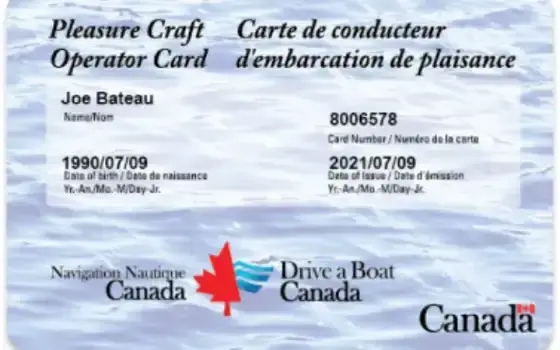
    ✅ A Pleasure Craft Operator Card (PCOC)
    ✅ A short online test with no practical exam

    That’s it. No on-water training, no supervised hours, and no real-world testing before taking control of a vessel.

    Why This Matters

    Many assume boating is easier than driving because there are no traffic lights or intersections. But waterways come with serious risks:

    ⚠ High Fatality Rates: Boating accidents claim 100+ lives per year in Canada, often due to inexperience.
    🌊 Environmental Damage: Mishandled boats can harm wildlife and cause fuel spills.
    🚤 Lack of Emergency Readiness: Unlike roads, there are no “emergency lanes” on water—operators must know how to handle breakdowns, rough weather, and navigation challenges.
    👨👩👧👦 Passenger Safety: A boat captain is responsible for everyone onboard, but without hands-on training, many don’t know basic safety procedures.

    A Graduated Boating License? It Just Makes Sense.

    Imagine if leisure boaters had to follow a tiered licensing system like drivers:

    1️⃣ Stage 1: Learner’s Permit
    ✔ Pass a written safety & navigation test
    ✔ Operate only under supervision

    2️⃣ Stage 2: Intermediate License
    ✔ Log a minimum number of hours on the water
    ✔ Pass a practical test covering docking, emergency stops & navigation

    3️⃣ Stage 3: Full License
    ✔ After proving competency & experience, receive full boating privileges

    This common-sense approach would drastically reduce accidents and ensure boaters actually know how to operate their vessels safely.

    Commercial Boaters Already Follow Stricter Rules

    While leisure boat operators get by with minimal training, commercial operators have much stricter licensing requirements. Every Palapa Tours captain, for example, holds a Small Vessel Operator Proficiency (SVOP) certification, which includes:

    ✅ Navigation & chart reading
    ✅ Emergency procedures
    ✅ Collision avoidance regulations
    ✅ Hands-on experience

    The next level up is a Master’s License, which comes with even more rigorous training. But let’s be honest—commercial operators aren’t the problem. Rogue leisure operators with no practical experience pose a greater risk to safety on the water.

    The Bottom Line

    If we require years of training for a teenager to drive a Honda Civic, why do we allow someone with zero real-world experience to captain a 30-foot pontoon loaded with passengers?

    A graduated boating license isn’t just a good idea—it’s common sense. Until then, if you’re hitting the water, treat boating with the same respect as driving. And if you’re unsure? Hire a licensed captain—because when it comes to safety, half measures just don’t float. 🚤⚓

  • Beware of Rogue Operators:

    Beware of Rogue Operators:

    Why Booking with Legitimate Boat Tour Operators Matters

    • Jet Ski Operators
    • Pontoon Tours
    • Yacht Tours
    • Motor Boat Tours

    As summer approaches and you plan your water adventures, there’s an important topic we need to address—legitimate boat tour operators versus rogue operators. While Transport Canada has been cracking down on illegal operators, the unfortunate reality is that many still exist. Choosing the right operator isn’t just about finding the best deal; it’s about ensuring your safety and peace of mind. At Palapa Tours, we’re committed to being a fully certified operator, and here’s why that matters:

    1. Insurance: Your Safety Net

    A legitimate boat tour operator carries proper commercial liability insurance—no exceptions. This insurance protects you in the rare event of an incident. Without it, any claim you make after an accident involving a rogue operator will likely be denied. Transport Canada mandates this insurance because your safety is worth the cost, even if it’s expensive for operators. Rogue operators, however, skip this crucial step, putting you at risk. Always ask to see proof of insurance covering each passenger for at least $250,000.

    2. Proper Safety Equipment & Inspections

    From lifejackets and fire extinguishers to flares, legitimate operators like us meet strict safety requirements. We undergo yearly inspections and follow rigorous daily safety protocols to ensure every trip is as secure as it is enjoyable. Rogue operators? They often don’t have enough—or any—of the necessary safety equipment to handle emergencies. While it might seem tempting to hop on a cheap, unofficial tour, remember: that operator likely doesn’t have the training or equipment needed to prioritize your safety.

    3. Licensing: Captain and Vessel

    Certified operators are held to higher standards because we’re not just operating leisure boats; our vessels are registered with Transport Canada as commercial vessels. This comes with a host of additional guidelines to follow. Our captains hold certifications like the SVOP (Small Vessel Operator Proficiency), SVDBS (Specialized Vessel Domestic Basic Safety), and Marine First Aid. These qualifications ensure your trip is in the hands of trained professionals—not someone with a pleasure craft license trying to make a quick buck.

    How to Spot a Rogue Operator

    Wondering how to tell if you’re dealing with a rogue operator? It’s simple:

    • Ask for proof of insurance: A legitimate operator will happily provide a copy of their commercial liability insurance.
    • Request a Transport Canada Captain’s License: A certified operator will always have this on hand.
    • Search the vessel on Transport Canada’s database: A properly registered vessel will show up as a commercial vessel. If it’s not listed, steer clear.

    Don’t settle for vague answers or excuses. You’re paying for the experience, and you have every right to ensure the operator meets the necessary standards.

    It’s All Fun and Games Until It’s Not

    While rogue operators may seem like a cheaper or more casual alternative, the risks far outweigh the savings. Your safety, your family’s safety, and even your wallet are on the line if something goes wrong. At Palapa Tours, we’re proud to be a Transport Canada-certified operator. We encourage you to ask us for proof of insurance, licensing, or any other paperwork—we’ve got it all, and we’re happy to show it to you.

    This summer, choose safety, professionalism, and unforgettable fun. Book with a certified operator and enjoy peace of mind while cruising the Ottawa River. We can’t wait to see you on board at Palapa Tours. Cheers to a safe and exciting summer ahead! 🌴⚓

    Book your certified tour today and experience the difference!

  • Alcohol & Boats

    Alcohol & Boats

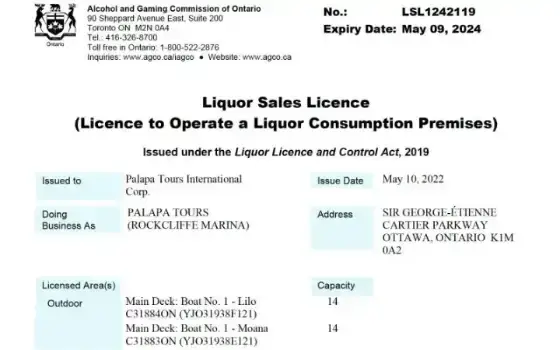
    A question we get quite often is is… how can you serve alcohol? The answer is fairly simple. Leisure vessels in Ontario are bound by the following rules.

    “Sec. 32 (3) No person shall operate or have care or control of a boat that is underway while there is contained in the boat any liquor, except under the authority of a license or permit.

    So how does one obtain a permit? You have to be a Commercial Vessel.

    LICENCES TO SELL LIQUOR

    1. A boat to which a liquor sales licence applies must have a minimum seating capacity of twelve people.

    R.R.O. 1990, Reg. 719, s. 14.

    Here is a direct Link to the Act

    We hope this clarifies any confusion and we look forward to serving you. We look forward to having you on our next boat ride.

    *** Please drink responsibly and don’t Drink and Drive any motorized vessel!